The Recycling Symbol Does Not Tell the Whole Story
The recycling symbol can identify a package material, but local rules decide what belongs in your bin. Learn how to check the item and collection route.
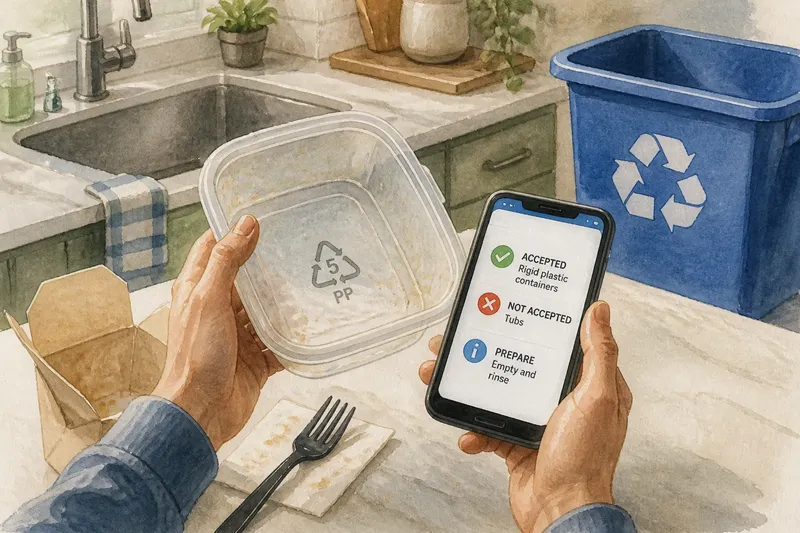
You finish a carton of takeout, spot the familiar recycling symbol on its bottom, and pause over the blue bin. That symbol can help identify a material, but it does not tell you whether your city accepts the item, whether it can be sorted, or whether it is clean enough for collection. Recycling rules make more sense when you check the material, the whole item, and the route it takes after pickup.
What does the recycling symbol actually tell you?
The chasing-arrows mark is often mistaken for a promise of recyclability. On many plastic packages, the number inside the symbol identifies a resin type: the kind of plastic used in the item. It is a material clue, not a direct instruction to put the package in a curbside cart.
That distinction matters because a recycling system must do more than recognize a material. A collection service needs to gather it, a sorting facility needs to separate it, and a buyer or processor needs to accept it for further use. A package can be technically recyclable in some setting and still lack a usable route in your neighborhood.
Symbols can also vary by packaging and location. A Möbius loop may appear without a number, while a resin code may be printed inside a triangle. Other marks may describe a component or disposal program. Read the words and symbols together; do not treat any one icon as a local collection rule.
Which situation are you in?
Start by identifying your collection setup. The right choice differs for a city curbside cart, an apartment building’s shared bins, and a drop-off program. Use the guidance that matches the place where this particular item will be collected.
- Your curbside service lists the item: Put it in the designated cart if the local instructions also match its material and form. The city or hauler’s accepted-items list reflects the route available to that service.
- Your building has shared bins: Check the building’s posted rules or ask the property manager which service collects them. A shared container may be handled by a different hauler from the one serving nearby homes.
- The item is not on the local list: Keep it out of the recycling cart unless the service directs you to a specific drop-off. An unlisted item can be routed with trash even when its packaging carries a familiar symbol.
- A store or community site accepts it: Use that route only if the program names the item or material. A drop-off bin may accept certain bags or films that curbside equipment cannot sort.
- You cannot confirm the route: Set the item aside while you check the local guide, or use the regular trash if no suitable collection option is identified. Guessing can send the item to the wrong stream.
Say you have a plastic tub marked with a resin code, and your city’s guide lists rigid plastic containers but does not mention tubs. Check the guide’s examples or contact the hauler before placing it in the cart. If the service confirms tubs are included, recycle it as directed; if not, use the disposal route the service specifies. The code alone cannot settle the decision.
Why does the whole item matter?
Packages are often combinations of parts, not a single material. A glass jar may have a metal lid and a paper label; a shipping envelope may pair paper with a padded plastic layer. The recycling symbol, if present, may refer to only one part.
Look for instructions that name the complete item, such as “empty and rinse” or “remove cap.” Follow them when the local program gives them. If the guide lists a container but says nothing about a loose attachment, do not assume that every piece belongs in the same cart. Check the program’s directions for lids, caps, pumps, sleeves, and other small parts.
Sorting equipment is built to handle particular shapes and materials. A small item can slip through machinery, while a flexible film can wrap around moving equipment. This helps explain why a material accepted through a store collection may be excluded from a curbside cart. The issue is not simply whether the material can be recycled somewhere; it is whether this item can travel through this collection and sorting system.
How should you handle food residue and confusing packaging?
Empty containers before recycling them, and use the local guide for any cleaning requirement. A few crumbs or a light coating may be treated differently from a container holding food or liquid. Avoid spending extra water or effort on elaborate cleaning unless the program asks for it.
When two materials are attached, check whether the package separates cleanly and whether the guide tells you to separate them. If directions are unclear, look up the brand’s packaging information only as a secondary clue; local collection instructions still decide what belongs in the cart. A manufacturer’s claim that a package is recyclable may describe a specialized program rather than your household service.
Some labels include terms such as “compostable,” “reusable,” or “made with recycled content.” Those descriptions do not mean the item belongs in recycling. Compostable packaging usually needs a composting route that accepts that specific product, while recycled content describes what went into making an item rather than where it should go afterward.
Where can you verify local recycling rules?
Use the information closest to the service that collects your waste. A city or county recycling page, a hauler’s accepted-materials list, or a building manager’s notice is more relevant than a general symbol guide. Search the exact item name, not just the material; “plastic” may be too broad to answer whether a takeout lid or a produce bag is accepted.
Collection instructions can differ even between neighboring communities. A city may contract with one sorting facility while another uses a different route, so a relative’s bin rules are not necessarily yours. If your guide has a search tool, try the package type and its material. If it does not, contact the service and describe the item, including attached parts.
Local instructions, manufacturer directions, and applicable program rules can differ; follow the guidance for the collection route you are using.
What should you do when the symbol and local guide seem to disagree?
Does a resin code mean my plastic container is recyclable?
No. The code identifies a type of plastic, but your local service decides which items it collects. Check the accepted-items list for the container’s form as well as its material.
Can I recycle a package marked “recyclable” if my city does not list it?
Not in the curbside cart unless the service confirms it is accepted. The label may refer to a different collection system or a specialized drop-off program.
Should I put a questionable item in the bin and let the sorter decide?
Do not use the recycling cart as a catch-all. An item that the system cannot sort may be removed as trash or interfere with other materials, so check the local instructions first.
What if I cannot find an answer for a package component?
Ask the hauler, municipality, or building manager, and describe the component rather than relying on a general material label. Until you have clear guidance, keep it out of the recycling cart.
How can you make the decision easier next time?
Save your local accepted-items page on your phone or keep a printed copy near the bins. A short note beside the cart can also help household members remember rules for items that cause repeated uncertainty, such as plastic film or food-soiled paper. Keep the note specific to your service rather than copying a generic recycling chart.
When deciding whether an item can be recycled, use the symbol as a starting clue, then match the complete item to the collection route. That small check is more useful than treating the arrows as a promise. If no local route accepts the item, choosing the instructed disposal option keeps it out of a stream it was not built to enter.