From Rain Barrel to Storm Drain: How Cities Learned to See Rainwater
City rainwater thinking connects rain barrels, storm drains, and planted streets, helping residents trace runoff and understand what happens after rain leaves a roof.
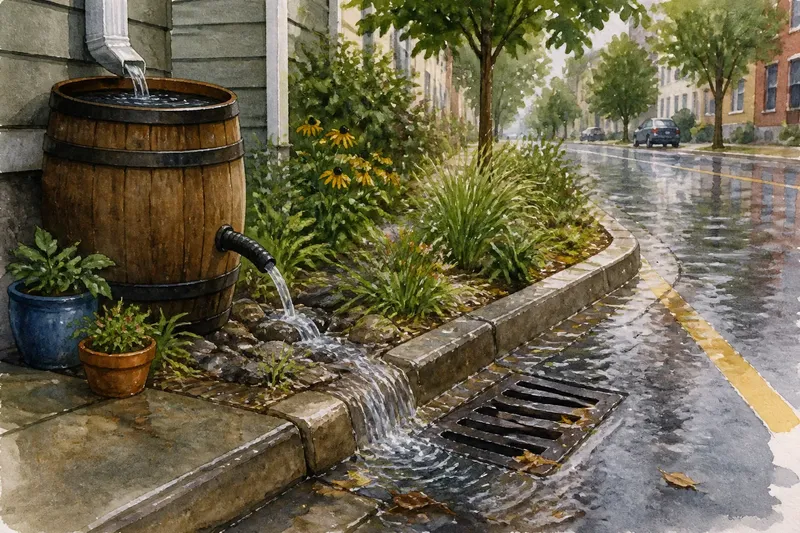
A downpour leaves a thin stream running along the curb. It slips through a storm-drain grate, and the street looks clear again. City rainwater thinking starts with that familiar moment: water disappears from view, but its route continues.
Rainwater infrastructure has grown beyond a simple choice between collecting rain and sending it away. Homes may store some water in barrels, pipes carry runoff through neighborhoods, and planted spaces can make parts of its journey visible. These approaches serve different purposes, and cities often use them together.
Why did households collect rain?
Where piped water was not readily available, a roof offered a nearby surface for collecting rain. A barrel under a downspout made the route easy to see: water ran off the roof and into storage for later use. Cisterns provided a similar form of household storage in places suited to collecting rain.
But storage had limits. A barrel could hold only the water that fit inside it, and its overflow still needed a safe route. Collecting rain at one home did not address runoff from streets, courtyards, or an entire neighborhood.
Imagine a homeowner with a small barrel under one downspout. During a storm, the barrel fills and water begins to flow from its overflow outlet. The visible result is both stored water and excess runoff that still needs to travel away from the house.
Why did cities build storm drains and pipes?
As cities became denser, more rain landed on roofs, paved yards, and streets instead of open ground. Runoff could gather on busy routes, disrupt travel, or reach buildings. Storm drains and underground pipes gave cities a way to carry that water toward an outlet.
A curbside grate is the visible entrance to a largely hidden network. Once water passes below it, a passerby may not know whether it travels to a nearby waterway or connects with other parts of the drainage system. The route depends on local infrastructure.
Pipes addressed a practical need: moving water away from streets and buildings. They did not make the rest of the route irrelevant. What rain encounters on its way to a drain still matters.
Why did runoff become a water-quality concern?
Rain flowing across pavement can pick up leaves, soil, litter, and residue. A storm drain is therefore more than an opening that removes water; it connects city surfaces to wherever the runoff goes.
This broader view adds questions about how water moves before reaching a drain. Can it be slowed? Can a planted area receive it? Can debris be kept from entering the flow? The answers depend on local conditions, design, and upkeep. Pipes remain necessary in many places, but the surfaces feeding them are part of the system too.
Runoff also crosses boundaries. Water from a roof may reach a sidewalk, then a street drain, and eventually a destination beyond a resident’s view. That makes rainwater a shared urban concern rather than a matter confined to one property.
How can streets make rain’s route visible?
Some street designs give runoff places to pause or soak in before it reaches a drain. Rain gardens, vegetated swales, permeable paving, and planted curb extensions can make part of the water’s route visible.
- A rain garden is a planted depression designed to receive runoff; if it has a clear inlet and an appropriate overflow route, it can be part of a site’s drainage plan, but if water has nowhere safe to leave, the design needs review.
- A vegetated swale is a shallow planted channel; if its shape guides water toward an intended outlet, it can make the flow easier to follow, but if it sends water toward a building or sidewalk, the route needs adjustment.
- Permeable paving lets water pass through the surface into layers below; if the underlying site is designed to receive that water, it can support infiltration, but if conditions are unsuitable, another drainage method is needed.
- A planted curb extension can receive runoff from the street; if its curb opening remains clear and the water reaches the planted area, the connection is visible, but if the opening is blocked, it needs clearing or maintenance.
- A sign beside a curb opening can explain where street runoff goes; if the wording matches the local drainage route, it can clarify the connection, but if the route is unknown, check with public works before describing it.
- A storm-drain grate carries water into the local network; if water enters freely, the inlet is doing its visible job, but if leaves or litter block it, follow local reporting guidance rather than assuming the whole network is at fault.
These features are not interchangeable, and none should be assumed to handle every storm or replace necessary drainage. Their value also lies in showing where water enters, slows, and leaves. A curb opening beside a planted area, for example, can make the connection apparent to someone walking past.
How does a rain barrel fit into city rainwater thinking?
A barrel offers a simple way to follow the parts of a small rainwater system: roof, downspout, storage, and overflow. It can store water for a later use, such as watering container plants, but it does not manage all the runoff from a property.
Say a resident has a downspout beside a patio and wants to water a few container plants. They check whether a barrel can sit securely beneath the downspout, confirm that its overflow can move away from the foundation, and plan to keep its screen and outlet clear. The expected result is water available for the plants and excess directed away from the wall. The setup still needs to follow local guidance and the barrel maker’s instructions.
Storage, infiltration, and conveyance describe different parts of the route. A barrel stores some water. A rain garden or permeable surface can change how water moves through a site. A storm drain carries runoff onward. Knowing which job a feature does helps explain why a city may use several approaches together.
What do people ask about city rainwater thinking?
Where does water go after it enters a storm drain?
The route depends on the local drainage network and its outlet. A city stormwater map, public works page, or watershed organization may help trace what lies beyond the grate.
Does a rain garden replace a storm drain?
A rain garden is generally one element of a broader drainage approach, not a universal substitute for pipes. Its role depends on its design, location, and intended purpose.
Why are messages painted near some storm drains?
Markings can remind people that street runoff has a destination and may carry litter or poured liquids with it. The message and the route it describes vary by community.
Can any home use a rain barrel?
Not necessarily. The downspout layout, available space, safe overflow route, and local guidance all affect whether a barrel is suitable. A local water or public works department can clarify community requirements.
How can you read a city’s rainwater route?
During ordinary rain, notice where water first gathers, whether a planted area receives it, and where it disappears. Those observations can help you distinguish visible storage and planted features from the hidden work of pipes.
For instance, imagine a walker sees water flowing from a curb opening into a planted depression, then notices a nearby grate. The walker can identify the visible connection to the planting, but should not assume what happens underground; a local stormwater map or public works page is the next place to check. That small distinction makes city rainwater thinking more accurate: follow what you can see, and verify what the grate conceals.