A Five-Minute Public-Space Walk Between Two Stops
A five-minute public-space walk between two stops can reveal who a plaza serves. Compare a direct route, a slower loop, and a pause-focused walk.
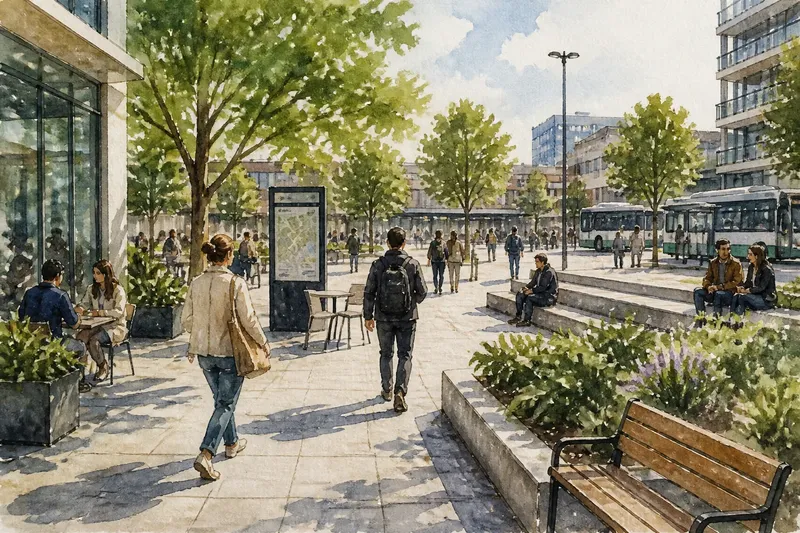
A five-minute public-space walk between two stops can tell you more than a glance from the sidewalk. Leave one bus stop, station entrance, or corner and head toward another, noticing how the space welcomes people in, guides them along its edges, and offers places to pause. The route is short; the point is to see who can use it without having to hurry, detour, or ask permission.
There is no single best way to make this walk. A direct crossing suits someone assessing everyday access. A slower loop reveals how a space feels beyond its main path. A pause-focused walk helps you notice whether people can stay, not just pass through. Choose according to the question you want the space to answer.
What can a short walk reveal?
Public spaces are often described by their names: plaza, park, forecourt, square. A walk makes the description more practical. You can see where people enter, which paths seem obvious, where movement narrows, and whether there is somewhere to stop without blocking others.
Keep the observation modest. You are not conducting a formal accessibility audit or judging every design feature. You are noticing the experience of one ordinary trip between two points. A route that feels easy to one person may be awkward for someone pushing a stroller, using a mobility aid, carrying bags, or moving with a child.
For a useful record, note three things: entrances, edges, and pauses. Entrances include gates, ramps, openings between buildings, and informal gaps people actually use. Edges are the lines along storefronts, planting, walls, traffic, or water. Pauses might be benches, broad steps, a low wall, shade, or simply a patch of space where standing does not interrupt the flow.
Should you take the direct route?
The direct approach follows the clearest line between the two stops. It suits a commuter, a visitor with limited time, or anyone asking whether the space works as a passage. Start at the point where you naturally arrive. Walk toward the other stop without deliberately seeking scenic features, and notice what draws you forward or makes you hesitate.
Watch for a visible entrance and a route that remains legible once you are inside. Does the path lead toward the destination, or does it fade into paving that could be a plaza, a queue, or a private forecourt? Notice whether a doorway, sign, fence, or cluster of furniture makes the route feel open or restricted.
The direct route also exposes small frictions. A narrow gap between a cafe table and a planter may be passable for one person but uncomfortable for a group. A path may be obvious from one side and hard to find from the other. Record the location and what you observed rather than guessing why it was designed that way.
Say you are walking from a library entrance to a bus stop across a small plaza. You notice that the straight path passes between a signboard and a table, while a wider paved route curves around them. If you take the direct approach, your note might be that the apparent shortcut feels tight when people are gathered there; the expected observable result is a clearer account of where passing and lingering compete.
When is a slower loop more useful?
A loop suits someone who wants to understand the space as a destination or meeting place, not only as a shortcut. Instead of crossing straight through, follow an outer edge for part of the walk, then turn toward the second stop. This can reveal secondary entrances and quieter corners that a direct crossing misses.
Edges help explain how a public space connects to its neighbors. A shopfront may make one side feel active, while a blank wall gives another side little reason to linger. A planted boundary can soften the edge, but dense or continuous barriers may make an entrance hard to spot. Notice what the edge invites you to do: approach, look in, sit nearby, or keep moving.
Pay attention to whether the loop remains comfortable for different walking speeds. A person moving slowly may need a clear path that does not require weaving through a gathering. Someone meeting a friend may prefer a visible landmark near the edge. You do not need to decide which use matters more; identify where they overlap and where the space makes one easier than another.
A loop takes more attention than the direct route, so it is a poor fit if you are trying to keep an appointment. It is useful when the first entrance seems obvious but you suspect the space has another way in, or when the route feels different from one side to the other.
Would a pause-focused walk suit you?
This approach is best for someone asking whether the space supports waiting, resting, or meeting. Walk at an unhurried pace and look for places where a person could stop without needing to buy anything. A bench is one option, but shade, a broad ledge, a sheltered alcove, or an open area beside the main path may also serve.
Look at the relationship between a pause and the route around it. A seat facing a busy path can make a meeting point easy to recognize, but it may leave little room for people to pass. A bench tucked behind planting may feel sheltered yet be hard for a first-time visitor to find. Neither observation settles whether the design is good; each tells you what kind of pause the spot appears to support.
Notice who can use the available places without needing to adapt their behavior. Are there options for someone standing briefly, someone sitting, and someone who wants to remain near a companion? Is a waiting place exposed to the main flow, or can a person move aside? These are observations about use, not assumptions about what any particular passerby needs.
How should you choose your route?
Match the approach to the question you have in mind:
- Choose the direct route to assess whether the space works as a clear connection between two destinations.
- Choose the slower loop to notice secondary entrances, changing edges, and differences between sides.
- Choose the pause-focused walk to see where someone can wait or rest without becoming an obstacle.
If you are unsure, take the direct route first. If you spot an entrance or corner you cannot explain from that crossing, use a later visit for the loop. If the space seems to move people through but offers few places to stop, make pausing the focus next time. Separating the questions keeps a short walk from turning into a vague list of impressions.
For any approach, write down what you saw in plain language. “There is a bench” is less useful than “the bench faces the path and sits beside the entrance.” Avoid turning a single visit into a broad claim about how everyone uses the space. A brief note can describe a moment and place without pretending to represent every day or every visitor.
What should you look for on a five-minute public-space walk?
How do I choose the two stops?
Pick two nearby, recognizable points, such as a transit entrance and a library door. Choose places you can identify from the public route, so your attention stays on the space between them.
What counts as an entrance?
Notice both marked openings and routes people can plainly enter from the public sidewalk. A gate, ramp, gap between buildings, or open corner may shape how inviting the space feels.
Should I watch other people?
Notice broad patterns without following, photographing, or making assumptions about individuals. You can record that people tend to pause near shade or pass along one edge without deciding why each person chose it.
What if the space is quiet during my visit?
Record the conditions you can observe, such as weather, nearby activity, or whether the space is open. Treat the walk as one snapshot rather than evidence that the space is always busy or always empty.
What makes a useful note afterward?
Keep the record short enough to reread. Write the route you took, one entrance that was clear or hard to notice, one edge that changed the feel of the walk, and one place where a person could pause. Add a specific question if something remains uncertain, such as whether a side opening is public or where a path leads.
A five-minute public-space walk works best as a focused observation, not a verdict. Choose the route that matches your question, notice the details that affect different passersby, and leave room for what you could not tell from one visit. That makes the next conversation about a plaza or park more concrete: you can point to an entrance, an edge, or a place to pause instead of relying on a general impression.